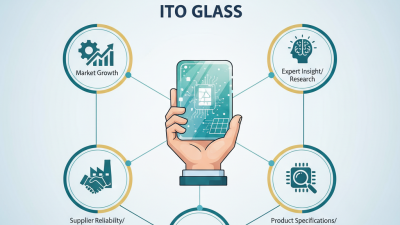
China Top 10 Ito Glass Types for Global Buyers?
Global buyers often search for the best Ito Glass, but “best” depends on the application. Touch panels, solar modules, automotive displays, and laboratory instruments require different performance balances. This guide introduces ten important Ito Glass types used across international supply chains. It compares substrates, coating structures, sheet resistance, visible transmission, thickness, surface quality, and processing flexibility.
David S. Ginley, a respected transparent-conductor researcher, explains, “Transparent conductors combine two normally contradictory properties: high electrical conductivity and optical transparency.” This principle remains central to Ito Glass selection. A buyer may prefer low resistance, yet excessive coating thickness can reduce clarity. Another buyer may need excellent light transmission, but accept higher resistance. Small differences matter.
The ranking considers practical purchasing questions, not only laboratory data. Can the glass survive cutting, bending, heating, or humidity? Are coating uniformity reports available? Can the supplier maintain stable batches? These details often decide production success. Real experience shows that a beautiful sample proves little. Consistency matters more.
This list is not perfect. Regional specifications, equipment limits, and project budgets can change the order. Some advanced types appear attractive but remain difficult to source reliably. Others seem ordinary, yet perform well for demanding, high-volume production. Buyers should verify test methods, warranty terms, packaging protection, and delivery history before placing orders. Clear evidence beats impressive promises.

ITO Glass Fundamentals and Its Role in Electronic Displays
ITO glass, or indium tin oxide coated glass, is a transparent conductor used in electronic displays. It allows electrical current to pass while letting visible light reach the viewer. This balance makes it valuable in touch panels, liquid crystal displays, OLED panels, and measurement equipment.
For global buyers comparing China’s top ten ITO glass types, the coating structure matters more than a product label. Common differences include substrate thickness, sheet resistance, light transmission, surface hardness, and coating direction. Low-resistance glass supports responsive touch sensing. Higher-transmission glass can improve screen brightness. However, these advantages may conflict. A thicker coating can reduce resistance but slightly affect optical clarity.
In practical sourcing, engineers should request test data from each production batch. Useful records include resistance mapping, haze, transmittance, coating uniformity, and adhesion results. Panel size also deserves attention. Large sheets may show edge-to-center variation if deposition control is weak. Small samples can look perfect.
But samples can mislead.
A reliable evaluation should include cutting, cleaning, lamination, and repeated electrical testing. These steps reveal defects that a visual inspection misses. Buyers should also confirm packaging methods, moisture protection, tolerance ranges, and traceability. ITO glass is not automatically suitable because it appears clear. Device design, climate, assembly pressure, and long-term use all influence the correct specification. Even experienced teams sometimes prioritize price too early, creating avoidable yield problems later.
China Top 10 ITO Glass Types for Global Buyers? - ITO Glass Fundamentals and Its Role in Electronic Displays
| No. |
ITO Glass Type |
Typical Glass Substrate |
Common Glass Thickness |
Typical ITO Sheet Resistance |
Typical Visible Transmittance |
Main Applications |
Key Buyer Considerations |
| 1 |
Standard Soda-Lime ITO Glass |
Soda-lime silicate glass |
0.7–1.1 mm |
8–100 Ω/□ |
80–90% |
Touch panels, laboratory electrodes, basic display components and sensors |
Cost-effective and widely available; confirm flatness, edge quality, coating uniformity and surface cleanliness. |
| 2 |
Low-Resistance ITO Glass |
Soda-lime or aluminosilicate glass |
0.7–1.8 mm |
4–10 Ω/□ |
75–88% |
Large-area touch sensors, heating elements, transparent electrodes and high-current test structures |
Lower resistance reduces voltage drop but may require a thicker ITO layer, which can reduce optical transmission. |
| 3 |
High-Transmittance ITO Glass |
Optical-grade soda-lime or borosilicate glass |
0.5–1.1 mm |
30–150 Ω/□ |
85–92% |
Optical sensors, display windows, photodetectors and transparent test electrodes |
Prioritize visible transmittance, haze, color neutrality and coating uniformity over minimum resistance. |
| 4 |
Low-Temperature ITO Glass |
Soda-lime, borosilicate or chemically strengthened glass |
0.4–1.1 mm |
20–200 Ω/□ |
80–90% |
Temperature-sensitive touch sensors, polymer-based devices and assembled electronic modules |
Verify the maximum deposition and post-processing temperature to prevent glass warpage or damage to adjacent layers. |
| 5 |
Borosilicate ITO Glass |
Borosilicate glass |
0.5–3.0 mm |
8–150 Ω/□ |
80–90% |
High-temperature experiments, laboratory instruments, microfluidics and specialty displays |
Offers better thermal-shock resistance and lower thermal expansion than ordinary soda-lime glass, usually at a higher cost. |
| 6 |
Ultra-Thin ITO Glass |
Thin soda-lime, aluminosilicate or borosilicate glass |
0.1–0.5 mm |
20–200 Ω/□ |
80–90% |
Compact displays, lightweight sensors, microdevices and space-constrained assemblies |
Check bending strength, handling requirements, bow, warp and packaging protection because thin glass is more fragile. |
| 7 |
Chemically Strengthened ITO Glass |
Aluminosilicate or specialty strengthened glass |
0.4–1.1 mm |
10–150 Ω/□ |
80–90% |
Portable touch interfaces, handheld instruments and impact-sensitive electronic displays |
Confirm whether strengthening occurs before or after coating, and validate adhesion, scratches and chemical compatibility. |
| 8 |
Patterned ITO Glass |
Soda-lime, borosilicate or aluminosilicate glass |
0.4–2.0 mm |
8–200 Ω/□ |
75–90% in active areas |
Touch electrodes, segmented displays, capacitive sensors and circuit prototypes |
Specify pattern tolerance, line width, isolation gap, alignment marks, busbars and residual coating at the edges. |
| 9 |
ITO Glass with Anti-Reflective Surface |
Optical-grade soda-lime or borosilicate glass |
0.7–2.0 mm |
10–150 Ω/□ |
85–94% |
Outdoor displays, optical instruments, vehicle interfaces and bright-environment touch panels |
Evaluate reflection, haze, viewing angle, coating stack compatibility and durability during cleaning. |
| 10 |
ITO Glass for Electrochemical and Heating Devices |
Borosilicate or soda-lime glass |
0.7–3.0 mm |
5–100 Ω/□ |
75–90% |
Electrochemical cells, transparent heaters, smart-window research and functional coatings |
Match sheet resistance to the required power density, operating voltage, electrolyte chemistry and thermal cycling profile. |
Technical note: The values shown are typical industry ranges for ITO-coated glass and can vary with glass composition, ITO thickness, deposition method, oxygen content, annealing conditions, coating pattern and measurement standard. Sheet resistance is expressed in ohms per square (Ω/□), while visible transmittance generally refers to the approximately 380–780 nm wavelength range.
The Top 10 ITO Glass Types Made in China
The Top 10 ITO Glass Types Made in China
Chinese manufacturers produce ITO glass in several practical configurations for displays, sensors, and laboratory equipment. The ten common types include standard soda-lime ITO glass, borosilicate ITO glass, tempered ITO glass, chemically strengthened ITO glass, ultra-thin ITO glass, large-format ITO glass, patterned ITO glass, low-resistance ITO glass, anti-glare ITO glass, and high-transparency ITO glass. Each type serves a different engineering purpose.
Soda-lime glass suits general touch panels. Borosilicate glass handles repeated heat exposure better. Tempered versions improve impact resistance, while ultra-thin glass supports lighter assemblies. Patterned coatings can define electrodes without extra masking steps.
Performance depends on more than coating presence. Buyers should check sheet resistance, visible transmittance, glass thickness, coating uniformity, electrode design, and allowable operating temperature.
Low-resistance ITO usually supports faster signal transmission, but it may reduce transparency slightly. High-transparency glass looks clearer, yet its electrical performance may not suit every sensor. Specifications can vary between batches. That matters.
Tips:
Request a sample before mass production. Measure resistance at several points, not only the center. Confirm the coated side with a documented test method. Ask for dimensional tolerance, packaging details, and inspection records. A supplier’s technical answer should match the sample. If it does not, pause and investigate. No single ITO glass type is universally best; application data must guide the final choice.
Key Specifications for Comparing ITO Glass Products
Comparing China’s top ten ITO glass types requires more than checking a catalog title. Suppliers may classify products by application, coating structure, or resistance range. Ask for measurable data.
Start with substrate thickness, glass size, sheet resistance, and visible-light transmittance. Common thicknesses may include 0.33, 0.55, 0.7, and 1.1 millimeters. Resistance is measured in ohms per square. Lower resistance can improve conductivity, but it may reduce transparency or increase cost. A low number is not automatically better. Check the test method, tolerance, and uniformity across the full panel. Request coating-side identification, surface roughness, haze, and optical distortion data. These details matter when a sensor must read through a clear window.
Temperature performance also deserves careful review. Confirm the operating range, heat-treatment limits, humidity resistance, and coating adhesion. For touch or display projects, ask about patterning accuracy, edge clearance, alignment marks, and cutting tolerances. For heating applications, verify power density and temperature distribution with a sample. A specification sheet may look complete, yet omit the real weak point: inconsistent resistance near the edges. Compare sample results with mass-production data. That step is sometimes missed. Require inspection records, packaging details, and traceability for each shipment. Before approving a supplier, test several pieces under actual assembly conditions, because laboratory figures rarely reveal every production problem.
ITO Glass Applications Across Global Industries
China Top 10 ITO Glass Types for Global Buyers?
ITO Glass Applications Across Global Industries
ITO glass is not one universal product. Chinese suppliers commonly classify it by sheet resistance, glass thickness, coating pattern, and end use. The practical “top ten” may include low-resistance touch glass, high-transmission display glass, patterned electrode glass, anti-glare glass, chemically strengthened glass, and versions for LCD, OLED, medical, automotive, industrial, and smart-window systems. The labels are not perfectly uniform.
In touch panels, ITO-coated glass carries transparent electrodes while preserving image clarity. A 2024 Grand View Research report estimates the global transparent conductive films market at about USD 6.6 billion in 2023, with continued growth through 2030. This demand reaches kiosks, payment terminals, factory HMIs, and medical monitors. Operators notice small defects: a visible haze line, uneven resistance, or a connector edge that lifts after cleaning. These details matter more than a polished sample.
Automotive and architectural systems use ITO glass for heaters, defogging, electromagnetic shielding, and interactive glazing. IDTechEx identifies transparent conductive films as enabling layers for displays, sensors, and energy devices, while market estimates differ by scope. Buyers should request four-point-probe resistance maps, optical-transmission data, adhesion testing, thermal cycling, and lot traceability. ASTM or ISO methods help, but the test setup must match the final assembly. A 2023 market estimate is not a guarantee for one factory. That distinction is easy to miss.
China Top 10 ITO Glass Types for Global Buyers
ITO Glass Applications Across Global Industries
This chart compares ten commonly specified ITO-coated glass configurations by representative sheet resistance. Lower resistance supports higher electrical conductivity, while higher-resistance grades are often selected for cost-sensitive sensors, displays, laboratory devices, and antistatic applications. Actual specifications may vary according to glass thickness, coating structure, optical transmission, and customer requirements.
How International Buyers Can Select Chinese ITO Glass Suppliers
China Top 10 ITO Glass Types for Global Buyers?
International buyers should select Chinese ITO glass suppliers by performance, not catalog size. Common options include soda-lime glass, borosilicate glass, strengthened glass, and ultra-thin glass. Buyers also compare sheet resistance, visible transmittance, haze, thickness, and coating uniformity. According to Grand View Research’s transparent conductive films report, the market is expected to grow steadily through 2030. This supports demand, but growth does not guarantee reliable production. Each supplier should provide recent test records, not only attractive samples.
Request four-point probe data across the full glass sheet. Check coating adhesion after humidity, heat, and repeated cleaning. Ask for lot traceability, inspection standards, packaging photos, and replacement procedures. ISO 9001 certification helps, but it is not proof of stable ITO performance. A 2024 report from MarketsandMarkets identifies display and touch applications as major demand areas. Therefore, suppliers should understand optical and electrical requirements together. A cheaper sheet may create higher assembly losses.
Tips: Send a clear specification table before requesting quotations. Include resistance tolerance, glass size, edge quality, and minimum order quantity. Ask for three production samples from different lots. Compare them independently. Do not rely on one test. Also review lead time during peak seasons. This detail is often missed. Chinese suppliers can offer strong customization, yet communication gaps may remain. Use drawings, acceptance limits, and written corrective-action records. Some buyers focus too heavily on price. That choice deserves reflection.


 Phone
Phone Send Email
 whatsapp
 Facebook